Google is back this year with its Made by Google event, and we’re expecting a lot of Pixel news. Of course, Google is set to launch the Pixel 11 series, which will likely include several different smartphones as well as a new foldable. In addition, Google is expected to launch the Pixel Watch 5, and there could be some additional devices in the mix.
We hope you’re as excited to learn about Google’s latest smartphones as we are! Last year’s launch was filled with celebrities and internet personalities, and this year looks to be no different, with Stephen Curry, Shubman Gill, Ayami Nakajo, and more, with Trevor Noah hosting.
Over the next few days, we’ll be going over what you can expect and covering the event live as it happens so you don’t have to miss a thing! Scroll down for all the details!
When and what time is Made by Google?
The event is Wednesday, August 12, and it starts at 3 p.m. PT / 6 p.m. EDT.
How to watch the Made by Google event?
Google will stream the event on its official Made by Google YouTube Channel. You can also watch it live at the Google Store website. Click the Notify Me button below so you don’t miss a thing!
2026-08-11T15:33:23.302Z
Did you know that someone apparently found a Pixel Watch 5 at the bottom of the ocean as far back as May? Someone posted photos of the device online, saying their friend found it while scuba diving in St. Martin. It’s kind of funny to think that a Google employee lost their Pixel Watch 5 prototype while on vacation, and it reminds us of how someone found the original Pixel Watch at a restaurant, sharing photos of the device exclusively with Android Central ahead of Google’s official announcement.
2026-08-11T14:00:30.463Z
While a lighter design would be good, I want to see a lighter battery on the Pixel 11 Pro Fold. My Pixel 10 Pro Fold doesn't quite manage to last an entire day, and this isn't generally a problem on any other foldable I use. The Find N6, on the other hand, lasts well over a day consistently. I'm optimistic that Google will figure out a way to boost battery life with the 11 Pro Fold, but I'm going to wait until I actually get my hands on the foldable before I make up my mind.
2026-08-11T12:50:55.312Z
Talking about batteries, we'll have to see if Google also switches to silicon-carbon tech. Samsung started using the tech in its latest foldables; that's the main reason why the Galaxy Z Fold 8 Ultra has a bigger battery while being thinner and lighter than its predecessor. The Pixel 11 Pro Fold could do with a thinner and lighter design, but will Google use silicon-carbon batteries or something else? We'll know tomorrow.
2026-08-11T12:01:34.770Z
Another thing to keep an eye on is battery life. Chinese manufacturers have made considerable strides in this regard in the last two years — mostly by adding huge silicon-carbon batteries — and it will be interesting to see how Google delivers better battery life this generation. We haven't gotten much in the way of information around this, but the few leaks point to Google going with a smaller battery in the Pixel 11 Pro XL. That sounds counterintuitive, but we will need to wait and see what Google does.
2026-08-11T10:44:39.879Z
That said, I am keen on seeing how the Tensor G6 holds up against its Qualcomm and MediaTek rivals. Google needs to show this year that it can deliver a platform that's at the same level. Thermal management is going to be a key area of focus as brands increasingly rely on local AI models, and this will be interesting to test on the Tensor G6 and its 2nm node.
2026-08-11T09:44:56.120Z
The main thing I want to see in the Tensor G6 is better gaming potential. The Pixel 10 Pro XL did a better job at this last year, but the Tensor G5-based phone still had a tendency to overheat in sustained gaming sessions, and Google needs to address that with the Pixel 11 models. While Google says that it prioritizes the AI side of things and tailors hardware to suit its Gemini models, there's no getting around the fact that these are high-end phones, and they need to measure up in all areas.
2026-08-11T08:16:38.260Z
Another interesting tidbit around the Tensor G6 is that it may be built on a 2nm node. This could give Google an advantage when it comes to efficiency, as a node shift from the existing 3nm to 2nm will ensure the same cores don't consume as much power to do the same tasks. With Qualcomm and MediaTek still on 3nm and not likely to switch to designs based on 2nm until next year, this is an area where Google could lead things on Android.
2026-08-11T07:35:24.663Z
On a more techie side, leaks say the Tensor G6 could bring MediaTek’s modem into the fold, not Samsung’s. Reports mentioned MediaTek’s M90 modem, specifically, which could offer 12Gbps speeds, dual-active 5G, and more. It’s not a lightweight modem by any means, and that might help the Pixel 11 stand taller. It would give consumers a crisp, smooth experience with their mobile data.
2026-08-11T06:35:34.390Z
While some Tensor G6 leaks for the Pixel 11 seemed positive, others brought us back down to Earth. What was weird (and incredibly important to me) is what was said about the chip’s GPU. Some claim the Tensor G6 could feature a “very old” GPU. The Pixel series hasn’t been the “greatest” for games. They do good, yes, of course. But rumors say the Pixel 11 might not perform any better than the Pixel 10 in this department (and I’m sad).
2026-08-11T05:47:43.307Z
If there’s one thing I’ve always wanted more of is Google’s in-house chip, the Tensor. I don’t mean that in the greatest of ways. What I mean is it’s lacking. Google hasn’t had the best track record with Tensor. Some Tensor G6 rumors (Pixel 11’s chip) said Google would chase a 2nm process. This would, in theory, improve its performance. How much? We’re not sure. You also can’t leave out Google’s AI; however, user health could take a few steps forward with this chip, too.
2026-08-11T04:46:39.373Z
Thinborne makes some pretty nice phone cases and, in typical fashion, it showcased a set of Pixel 11 cases way earlier than you’d usually expect. We had no clue where to turn with these, but one thing was significant: the cases had a wider camera bar cutout. You remember all those “Pixel Glow” talks, right? Things might not play out how we think.
2026-08-11T03:44:28.087Z
Another feature we've been hearing about for months now is finally expected to arrive with the Pixel 11 series: Night Sight Video. Google is reportedly bringing Ultra Low Light Video to the lineup, allowing users to record much brighter videos in extremely dark conditions. If it ends up being anything like what Night Sight did for phone photography all those years ago, this could easily become one of the biggest camera upgrades on the Pixel 11.
2026-08-11T02:29:30.409Z
Speaking of cameras, one upgrade I'm actually looking forward to is the touted 120x Pro Zoom on the Pixel 11 Pro. Google already does a great job with computational photography, and while the phone still uses a relatively modest telephoto camera, AI does a lot of the heavy lifting. It'll be interesting to see whether Google can make 120x zoom genuinely useful, or whether it's just another big number for the spec sheet.
2026-08-11T01:48:05.255Z
One leak I wasn't expecting is that the standard Pixel 11 might lose its telephoto camera. Google only added a telephoto lens to the base Pixel last year with the Pixel 10, but now there are reports suggesting it's going away again, possibly to help keep costs under control. Instead, the Pixel 11 is said to ship with just a 48MP main camera and a 13MP ultrawide. If that's true, it'll actually be a downgrade from the Pixel 10.
2026-08-11T00:29:46.326Z
It also looks like Pixel Glow, or HiLight, won't be available across the entire Pixel 11 lineup. According to the latest leaks, the feature will be exclusive to the Pro models. In fact, Google is reportedly redesigning the camera housing on the Pixel 11 Pro Fold to make room for the new LED. It'll be interesting to see whether this becomes a long-term Pixel design language, much like the camera bar did a few years ago.
2026-08-10T23:21:25.007Z
Remember the glowing light bar Google teased on Googlebook earlier this year? Well, it now looks like it's officially coming to the Pixel 11 series, and it may be called HiLight. According to the leaks, it'll light up when you're interacting with Gemini and will even change colors dynamically, making it feel like a modern version of the old Android notification LED. I just hope Google lets us customize it. Imagine assigning different colors to different contacts, so you'd know who's calling or messaging even when your Pixel is face down.
2026-08-10T22:09:11.647Z
On to the Pixel 11 series, I'm tentatively looking forward to the new displays Google will inevitably use in these phones, but not for the same reason as many other people. We're not expecting any revolutionary changes here, likely just another bump in brightness for all four rumored models, but I am hoping that Google enhances its "sensitive eyes" feature that launched with the Pixel 10.
If you're not aware, the Pixel 10's display accessibility feature doubled the PWM dimming rate, but those numbers weren't high enough to fix these painful displays for people sensitive to flicker. Instead, Google will need to increase that rate by at least 10x (something most smartphone companies have done at this point), or disable PWM dimming entirely (as Motorola and Honor offer), to make its OLED displays comfortable for this group of folks. Here's hoping!
2026-08-10T20:46:01.129Z
And before I move on from the Pixel Watch 5 rumors, I'm also quite stoked about the rumored changes to fitness tracking. One of the reasons I've stopped using Wear OS entirely is because fitness tracking on the platform is extremely lacking when compared to brands like Amazfit, Garmin, and Coros. Seeing as how I only use smartwatches for fitness tracking these days, this is a key feature for me.
I'm probably echoing Derrek's sentiments too much from earlier, but the point is that I know Wear OS can do so much better than it currently does, especially with the powerful chipsets inside and the excellent software Google has been building over the past few years since the big Wear OS reboot.
2026-08-10T19:33:48.513Z
While Derrek might be disappointed in the rumor that the Pixel Watch 5 isn't going to use the new Snapdragon Wear Elite chipset, I'm actually quite happy to hear this news. I've (Nick Sutrich) been using the Galaxy Watch Ultra 2 for the past two weeks, which uses that new Snapdragon Wear Elite chipset, and the battery life is comparatively awful compared to any other recent Snapdragon Wear chip I've gotten my hands on.
The W5 series, by comparison, seems to have a much better performance efficiency balance than Qualcomm's newest supercharged chip. Considering all the Pixel Watch models powered by Snapdragon still feel snappy to this day, I'd much rather stick with this more efficient chipset line than something that's unnecessarily more powerful.
2026-08-10T18:25:14.071Z
One change I’m hoping to see with the Pixel Watch 5 is an upgrade to the fitness tracking. Garmin is my go-to for fitness because it can set detailed workout routines and track reps and sets. As someone who frequents the gym and lifts weights, this is incredibly useful to me, and the reason why I switch out my Pixel Watch for the Garmin Venu 4 when I work out. If the Pixel Watch 5 can get this right, I can probably just stick to one smartwatch going forward. That said, I won’t get my hopes up.
2026-08-10T17:27:28.292Z
Speaking of keeping costs down, it looks like even Google won’t be able to avoid the inevitable price increase with the Pixel Watch 5. One rumor points to Google increasing the base price by $50, bringing it to a starting price of $399 for the 41mm variant. Would you pay that much for a smartwatch?
2026-08-10T15:39:53.070Z
I’m also excited to see what’s coming with the Pixel Watch 5. Based on Google’s teaser, it won’t look much different from the Pixel Watch 4, which has been one of my favorite smartwatches in the past year. However, early rumors suggest there also won’t be a change in chipset, while more recent rumors suggest it’ll feature an “Accelerated” version of the Snapdragon W5 Gen 2. It’s a bummer that it may not feature the premium “Snapdragon Wear Elite” found in the new Galaxy Watch 9 and Ultra 2, but last year’s chip was no slouch, and it’s likely this is to help keep costs down while providing more AI capabilities.
2026-08-10T14:13:30.997Z
I’ve (Derrek Lee) been using the base Pixel 10 for about a year, and it’s quite a step-up from the Pixel 9. The cameras are phenomenal, and I love the Qi2 support since it doesn’t force me to put a case on this already thick phone.
I’m curious how the Pixel 11 will upgrade the base Pixel experience, perhaps with more base storage and faster charging?
It would also be nice if Google made the Pixel 11 a bit thinner, perhaps by giving it a denser silicon-carbon battery… but I won’t get my hopes up.

2026-08-10T13:07:28.332Z
Chromebooks have dominated classrooms over the last decade, and it is a bold bet by Google to switch things up with the Googlebook. The high-end hardware combined with tight-knit integration with Gemini is interesting, but Google is going up against a well-established Windows ecosystem and MacBooks. I guess we’ll have to wait and see where the initial batch of Googlebooks slot in; that will give us a good idea as to what Google is planning to get out of its latest product category.
2026-08-10T12:30:32.112Z
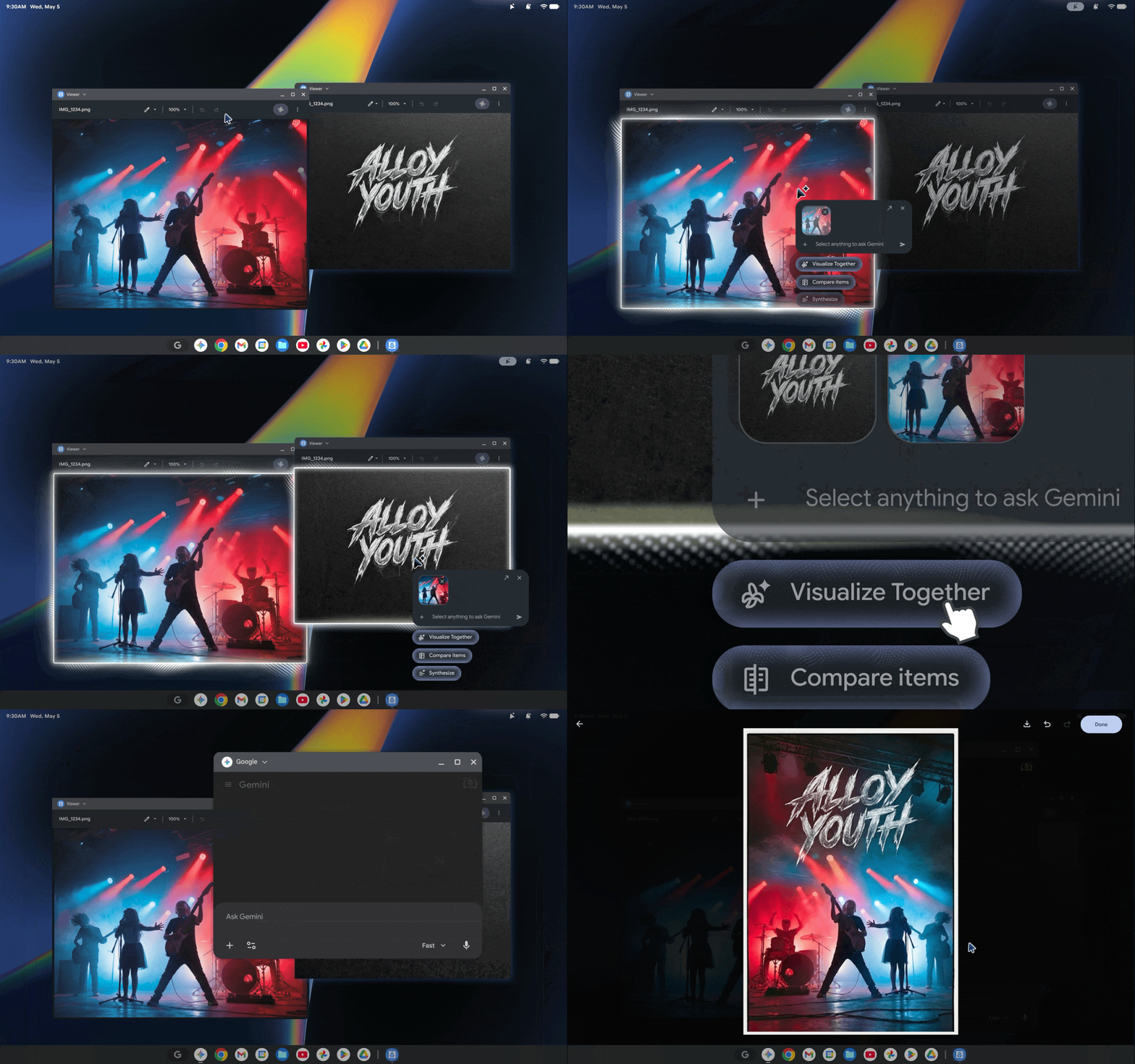
The defining feature of the Googlebook is the Magic Pointer, where you can easily get contextual information from Gemini just by wiggling your cursor at whatever you're browsing. This is what Google says when it's talking about Gemini Intelligence being integral to the Googlebook, and I'm very excited to see how it holds up in daily use.
2026-08-10T11:11:57.518Z

What's notable with the Googlebook is that it could showcase what Android and ChromeOS can do together. Google is going about this the right way, with major hardware vendors slated to release Googlebooks later in the year. The software will ultimately prove to be the defining factor, and I think there's definitely potential to see how Google brings Android and ChromeOS together into a unified ecosystem.
2026-08-10T10:21:32.198Z
Returning to highlights of The Android Show, the Googlebook teaser got everyone excited about how Google will deliver the Chromebook successor. What stands out this time is that the Googlebook is aimed as a high-end device, with Google noting that it puts Gemini front and center. We'll also get a mix of regular x86-based models and Arm devices, and I'm interested in the latter — there's much better battery life with Arm notebooks in general, and I can't wait to see how Google utilizes this with the Googlebook.
2026-08-10T08:57:51.094Z
What I like the most in Android 17 is the Bubbles multitasking mode. The ability to use floating windows allows much greater flexibility, and it makes a lot of sense on a foldable like the Pixel 10 Pro Fold. There's better fluidity in general with the interface, and this was a phoe problem in the past.
2026-08-10T08:04:22.628Z
Samsung also joined the Android 17 bandwagon with its foldables, and the Galaxy Z Fold 8 models come with One UI 9.0 and the latest version of Android out of the box. Of course, Samsung's vision of Android looks very different to what Google has on the Pixels, and that's one of the best things about Android; you can choose what kind of interface you want on your phone. On that note, other brands are starting to roll out the stable Android 17 update to their phones, with Xiaomi getting us underway.
2026-08-10T07:07:19.438Z
One of the main reasons why Google pushed the Android release ahead last year is to ensure its latest devices get the latest build of the OS out of the box. With Google releasing phones in August and subsequently rolling out a new Android version in the month of October didn't really make much sense, so it's good to see Android builds coming out earlier. The stable Android 17 version was released on June 16, and Google's eligible devices have made the switch already.
2026-08-10T06:04:29.324Z
Be honest: Android Auto has been lacking, right? If you’re asking me, I’d say “kind of.” Google has continued to improve Android Auto over the years. Gemini’s involvement has helped, too. At the Android Show, Android Auto was shown with a vastly improved, “immersive” Google Maps experience with an edge-to-edge display, and a robust 3D view. Android Auto will tell you what you should keep an eye out for, like traffic lights and lanes. It’s no longer generic. It’s actually helpful.
2026-08-10T05:03:30.137Z
Since we’re now, officially, in the second half of 2026, we should start seeing Google’s upgraded Live Threat Detection. This will deliver “warnings about suspicious behavior that could be potentially harmful.” Take, for example, an app trying to force a text message to another number you don’t know. The idea is to ward off malicious trickery, and there’s a chance we’ll see this talked about with the Pixel 11’s launch.
2026-08-10T04:04:15.022Z
Another Android upgrade Google gave us—in line with its recent behavior—involved scam protections. At the Android Show 2026, Google talked about protections for your banking apps by introducing “verified financial calls.” We work hard for our money. The last thing we want is for it to get swiped. If Google deems that call to be a fraud, it will tell you to hang up now.
2026-08-10T03:01:45.797Z
While we wait for Made by Google, why not have a little to snack on? The Android Show this year talked up the company’s security improvements. One of the major highlights was Location Access. I know, I thought the same thing. Google made this more transparent so we can manage how an app accesses our location, and when it happened. We don’t always want to put ourselves out there like that, so I like that Google worked this into Android.
2026-08-10T01:56:18.273Z
Another Android 17 feature I'm really looking forward to is Rambler. I've talked about it before, but it's essentially Google's new AI-powered voice typing system. Instead of speaking carefully and trying not to make mistakes, you can just talk naturally. Rambler automatically ignores your "ums" and "ahs," understands corrections as you speak, and turns everything into properly formatted text. It's very similar to what we've recently seen with Gemini on macOS, but this time it's coming to Android smartphones. That's one of the Android 17 features I'm probably most excited to try.
2026-08-10T00:53:54.120Z
Speaking of the Pixel launch event, as a Pixel 10 Pro owner, I'm honestly not that excited about the Pixel 11 series itself. Based on everything we've seen so far, there don't seem to be many major hardware upgrades this year. What I'm actually looking forward to is Android 17 and the new features launching alongside the Pixel 11.One feature I'm especially excited about is the new 3D emojis. Google first showed them off during The Android Show, but we still haven't seen them arrive on Pixel phones. They're still not quite on the same level as Apple's emoji design, in my opinion, but they're definitely a big improvement over what Android has today.
2026-08-10T00:53:26.704Z
Speaking of Googlebook, Google has been unusually quiet about it ever since The Android Show. That makes me wonder whether the upcoming Made by Google event could finally give us a proper look at Google's next-generation premium laptops. What do you think? Do you expect Googlebook to make an appearance next week? Let me know in the comments.
2026-08-09T22:57:59.649Z
Since we're looking back at The Android Show from earlier this year, it's worth remembering that it was actually the first time Google quietly gave us a look at what is now rumored to be called Pixel Glow, or HiLight.
During the Googlebook teaser, you could spot a glowing light bar across the top of the laptop lid. Since then, we've seen the same design language appear on the new Google Home Speaker, and according to recent leaks, it's also expected to make its way to the Pixel 11 series.
2026-08-09T22:01:42.276Z
One of the other Gemini highlights from The Android Show 2026 was the new Create A Widget feature, which turns Gemini into a professional coder so you can make custom home screen widgets. Nothing started this trend a few months ago and did a spectacular job with the implementation, and I expect to see Google take the concept even further on the Pixel 11.
The concept is pretty simple. Say you want a specific widget that doesn't seem to exist in the Play Store. Just ask Gemini to create a widget for you, and it'll begin the coding process, complete with the ability to revise and modify things as the widget is being built.

2026-08-09T20:47:49.043Z
For me, the most interesting part of Gemini Intelligence and automation is when Gemini is used to interact with apps that aren't usually deemed "compatible." Let's say you're particularly find of an obscure note app that wouldn't normally have tie-ins with services like Gemini. No problem, because Gemini Intelligence is supposed to be able to work with it, regardless.
Say you took a photo of a banner or poster for an upcoming event and want to make a shopping list based on what you'll need for it. Gemini can help navigate the content in the photo and fill out a note in your favorite app without you manually typing it in. That's just one of many features we're expecting to see expanded on the new Pixel 11 series, too!
2026-08-09T20:02:36.771Z
Google was already in the midst of doing some heavy brand reworking with Gemini, and Android 17 only furthers those actions. Google says that Android is no longer an "operating system" but, rather, an "intelligence system." This sounds like marketing nonsense, and I'm some of it certainly is, but the idea is that Android is moving beyond a traditional point-and-click (or tap) UI and, instead, becoming a system that does exactly what you ask of it.
Case in point, the newer Gemini Automation features which will navigate entire apps and websites for you with a single command. I used it to order food and tea from two different restaurants and all I had to do was hit confirm. While I'd argue that having Gemini order food for me is silly and completely unnecessary, seeing Gemini have the ability to navigate complex UIs without error is impressive, and there will no doubt be more sensible reasons to use this feature in the near future.
2026-08-09T20:01:18.288Z
Android 17 is shaping up to be a more social-media-focused update, and on the other side of Pause Point, the company launched Screen Reactions, which makes it incredibly easy to record yourself over another video. It’s an incredibly useful feature and very easy to use. It makes me wonder what other social features the Pixel 11 will introduce.
2026-08-09T20:00:38.141Z
Another feature I hope to see on the Pixel 11 Pro Fold is the Gamepad. It basically turns your foldable into a mini game console of sorts with a dedicated control pad on the bottom half of the screen, which should enhance the gaming experience. Google also says it will include native controller remapping for those of you who use external controllers, which is a great way to appeal to mobile gamers.
2026-08-09T15:32:06.722Z
One feature I can’t wait to get my hands on is Pause Point. It’s supposed to remind you to take a break from distracting apps with things like timers, breathing exercises, and even suggestions for less-distracting apps to use. Because we all need a reminder to take a break from social media, right? It’s actually a pretty thoughtful feature, one I never expected from Google.

2026-08-09T14:07:01.191Z
Google has been low-key hyping up its Pixel 11 series for some time, although we just didn’t know it. Earlier this year, the company gave us a glimpse of new features arriving with Android 17, and while the update is already out, there are still some features that haven’t arrived yet, and likely more that Google hasn’t even teased. What are you looking forward to the most?
